
AI Readiness Checklist: 6 Questions to Find Your First 3–5 Workflows to Automate
AI is not a strategy. It is a shortlist: the 3–5 workflows that repeat, sit on one person's memory, and leak revenue when late. Run this 6-question audit to find yours.
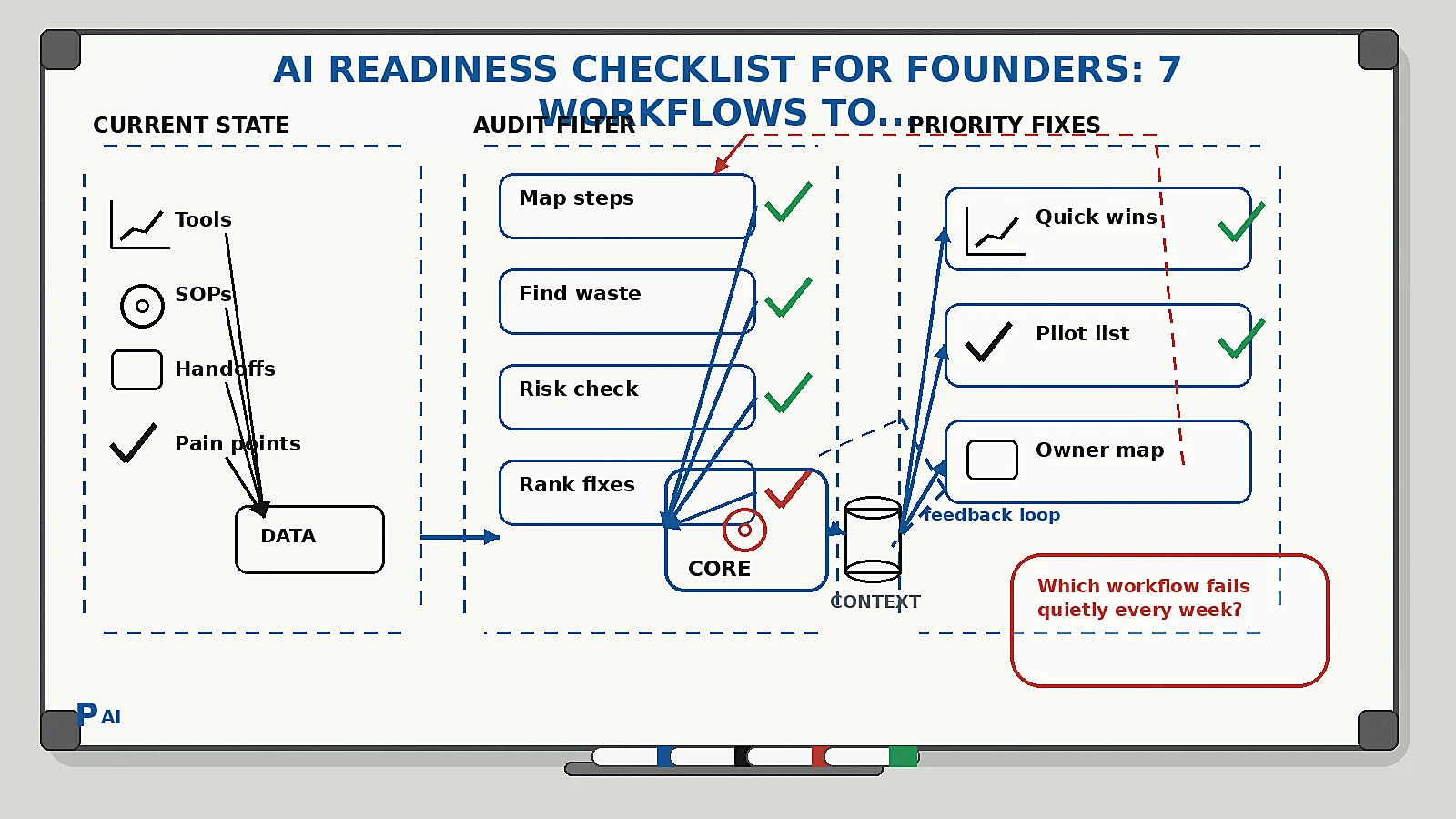
Quick answer
The first step with AI is not a tool. It is a shortlist: the 3–5 workflows that repeat, sit on one person's memory, and cost more in missed follow-up than in tooling. Audit those first. Everything else waits. If a workflow does not repeat or does not leak revenue, it is not a first candidate.
AI is a shortlist, not a strategy
Founders often ask "Where do we start with AI?" — and the market answers with tool lists, vendor comparisons, and hype. The honest answer is narrower: your business has maybe 3–5 workflows worth automating this quarter. The other 50 will still be there next year, undead in a spreadsheet.
The trap is starting wide. "Let me AI everything" produces a tool graveyard, not a system. Start narrow. Ask six things about a workflow. If it clears all six, it is a first candidate. If not, it waits.
The readiness audit: six checks
Run every candidate workflow through these six checks. Be honest — a "yes" that requires a caveat is a "no."
| # | Check | Pass if | Fail if |
|---|---|---|---|
| 1 | Repeats | Happens daily or weekly on a schedule | Once in a blue moon |
| 2 | Memory-held | One person (often the founder) knows the steps | Already documented and owned |
| 3 | Revenue-leaking | Late = lost lead, booking, or order | Late costs nothing |
| 4 | Machine-first | AI can hold attempt one | Needs human judgment every time |
| 5 | Human-for-hard | Escalation is a named person | Robot owns the final answer |
| 6 | Measurable | You can see the result in a week | No way to tell if it worked |
Scoring: 6/6 = automate this quarter. 4–5/6 = fix the gaps first. ≤3/6 = not a first candidate.
Three industry walks
The same six checks apply across industries. The workflows that pass look different, but the pattern is identical.
Real estate: site-visit follow-up
- Repeats: Every new listing inquiry.
- Memory-held: The agent who took the call knows the next step.
- Revenue-leaking: 40–60% of inbound leads die between first reply and second follow-up (Lion CRM).
- Machine-first: A text-back acknowledgement + CRM task creation is machine-work.
- Human-for-hard: Pricing, negotiation, legal — agent owns those.
- Measurable: Response time, tasks created, visits booked — all visible in a week.
First candidate: Inbound lead acknowledgement → CRM record → agent task with due time.
E-commerce / D2C: COD confirmation & shipping questions
- Repeats: Every cash-on-delivery order, every "where is my order" message.
- Memory-held: Support inbox or founder's phone.
- Revenue-leaking: Unconfirmed COD orders convert at a fraction; shipping questions unanswered = returns.
- Machine-first: Template confirmation, tracking link delivery, FAQ replies.
- Human-for-hard: Refunds, complaints, address changes — support lead owns.
- Measurable: COD confirmation rate, first-reply time, tickets resolved without human touch.
First candidate: COD order confirmation flow + tracking delivery via WhatsApp.
Clinics & hospitality: after-hours booking & callbacks
- Repeats: Every missed call after 6 pm, every "can I book for tomorrow?" message.
- Memory-held: Voicemail or the front desk's memory.
- Revenue-leaking: Roughly 1 in 2 peak calls missed; ~1/3 of restaurant calls unanswered (Hey Buddy). Clinics see 30–40% inbound missed-call leakage.
- Machine-first: Acknowledgement text-back, callback window card, slot offer.
- Human-for-hard: Clinical triage, VIP handling, deposit disputes — named owner.
- Measurable: Callback window hit rate, slots filled from missed calls, no-show reduction.
First candidate: After-hours missed-call acknowledgement → callback window card → morning queue.
How the first 3–5 map to Pratap offers
The audit doesn't just produce a list — it points to the right build:
| Audit flags | First offer to engage |
|---|---|
| Missed calls, after-hours leakage, callback window needed | Voice Calling Automation |
| WhatsApp inbound volume, shared inbox chaos, owner assignment missing | WhatsApp Business Automation |
| Competitor response speed, lost deals to faster rivals, no visibility | Competitor Analysis |
You don't lead with all three. The audit tells you which one earns the first conversation.
What to skip (and why "automate everything" is the trap)
Do not start with:
- A public chatbot that can invent policy
- Full calendar booking without confirmation rules
- A second CRM "just for automation"
- Voice AI that answers every call before text-back and ownership exist
- "AI employee" platforms with no completion signal
These are second-quarter problems at earliest. The first quarter is about closing the loops that already leak.
FAQ
What is an AI readiness audit?
A practical 20-minute diagnostic that applies six checks to your actual workflows and hands you a shortlist: the 3–5 worth automating this quarter, in order.
How long does an AI readiness audit take?
20 minutes on a call. The output is a written shortlist with owners, triggers, and a map to the right Pratap offer — Voice, WhatsApp, or Competitor Analysis.
Which workflows should I automate first?
The ones that repeat daily/weekly, sit on one person's memory, leak revenue when late, can be handled by AI on attempt one, have a named human for exceptions, and show measurable results in a week.
Do I need to automate everything at once?
No. Automate one loop, prove it for two weeks, then add the next. Starting wide is how you build a tool graveyard.
Should I hire an agency or use a tool?
Neither — yet. First, name the workflow. Then decide whether the build is a configuration (n8n/Make/Zapier), a custom agent, or a managed system. The tool follows the workflow, not the other way around.
Practical takeaway
AI is not a strategy. It is a shortlist. Run the six checks on every workflow you're tempted to automate. The ones that clear all six are your first 3–5. Everything else can wait a quarter.
If you want the six-check worksheet or a 20-minute AI Readiness Call that hands you the shortlist, start a conversation. No pitch, no price talk — just the audit.
Recommended reads
What Should You Use AI Agents For? A Practical Founder’s Playbook
The best way to use AI agents is not to start with models or tools. Start with repeated work, low-value admin, research loops, and personal friction points you already understand, then give agents narrow jobs with clear review steps.
Semantic Memory Substrate: Why AI Agents Need Shared Company State
A company brain is not another app that remembers things. It is a shared semantic memory substrate that lets humans and AI agents work from the same facts, decisions, permissions, and history.