Insights & Guides
Blogs
Practical playbooks on AI agents, workflow automation, and customer communications — written from real client work, not theory.
All articles

Next-Morning Inquiry Recovery: The First WhatsApp After They Did Not Confirm
When an inquiry is still unconfirmed the next morning, send one same-thread recovery message, name one owner, and stop if they stay silent.
WhatsApp Delivery Delay Notification: Tell Them Before They Chase You
Own a slipped delivery date on WhatsApp before the customer asks. Log the old date, new date, reason, and next action on one record.
WhatsApp Payment Confirmation Workflow: Close the Loop Before the Customer Asks
Treat every WhatsApp payment as four states: link sent, paid, needs a person, closed. Confirm on the same thread, stop reminders, and start the next step of the job.
WhatsApp Callback Request Workflow: Turn Call Me Into an Owned Slot
When a customer texts call me, treat it as a booking request. Capture the slot, owner, and outcome so the callback does not vanish in chat.

One Customer Record Across WhatsApp and Voice: The Multi-Channel Workflow That Stops Context Loss
Build a single customer record that carries context across WhatsApp, voice calls, and your CRM. When a lead messages on WhatsApp, then calls, then gets a follow-up — the owner sees the full thread, not fragments. The workflow: one record, shared state, named owner at every step.
After-Hours WhatsApp Auto-Reply: The Recovery Message That Holds the Lead
Set an after-hours WhatsApp auto-reply that acknowledges the message, sets a real response window, and names the next step. Pair it with a morning follow-up on the same thread so you do not lose the enquiries your competitors are ignoring after hours.
WhatsApp Invoice Collections: The Workflow That Stops Chasing and Starts Collecting
Most businesses chase invoices the same way they chase leads — with no stop rule, no named owner, and no clear escalation. This workflow turns invoice follow-up into a clean operating loop: state machine, stop rules, and human escalation only where the money actually moves.

After-Hours Voice + WhatsApp: The Booking Recovery Workflow for Clinics and Hospitality
Voice answers the night call and holds the slot. WhatsApp confirms and reminds on the same record. The front desk walks in to a clean board — not a voicemail pile.
Same-Shift Lead Confirmation: The Follow-Up Rule Most Teams Skip
An inquiry without a same-shift confirmation is not a lead. It is tomorrow's leak. Every inquiry received during operating hours needs a named next step before the shift ends: site visit time, COD check, or appointment slot.
When to Stop Following Up a Lead: Two Touches, Then Escalate Once
After two unanswered attempts on the same inquiry, stop auto-chasing. Keep the thread, assign a named human, send one last useful message, then close the card.
WhatsApp Appointment Reminder Workflow: Confirm the Slot Before They No-Show
A practical WhatsApp appointment reminder workflow: confirm at booking, remind 24 hours and a few hours before, then flag unconfirmed slots so staff can fill them.
WhatsApp Quote Follow-Up Workflow: Don't Let the Estimate Die in Silence
A practical WhatsApp quote follow-up workflow so sent estimates get a reply, a decision, or a clean close — without turning your team into collections.

AI Receptionist Cost for Small Business in 2026
AI receptionist pricing in 2026 falls into four bands: $25–100/mo entry SaaS, $100–300/mo mid-market, $300–1,000/mo managed, or $3k–10k custom build. Per-minute stacks land near $0.09–0.36/min. Price the missed-call recovery and human escalation path before you pick a vendor.

AI Receptionist vs Missed-Call Text-Back: What to Start With
Compare an AI receptionist, missed-call text-back, and an answering service. See which job each one owns, what must stay human, and how to keep one customer record.

AI Readiness Checklist: 6 Questions to Find Your First 3–5 Workflows to Automate
AI is not a strategy. It is a shortlist: the 3–5 workflows that repeat, sit on one person's memory, and leak revenue when late. Run this 6-question audit to find yours.
WhatsApp CRM Owner Assignment for Small Business
A WhatsApp CRM only works when every chat has one owner, a next step, and a handoff. Use this assignment rule before you add more inbox tools.

What to Automate First in a Small Business (Without Buying a Stack)
Most small teams do not need a new stack. They need one leak closed: missed follow-up, one owner, and a record that actually updates. This is the order to automate first.

How to Automate Customer Replies Without Sounding Robotic
Most "robotic" customer replies are not a technology problem. They are a wording and ownership problem. This guide shows how to automate routine replies on WhatsApp and email while keeping a voice that reads like a real person.
WhatsApp Message Templates: How to Reconnect With Customers After the 24-Hour Window
WhatsApp message templates are pre-approved business messages that let you reach a customer after the 24-hour customer-service window closes. Here is when you must use a template, how to get it approved, and the categories that matter for a small business.

WhatsApp Business App vs WhatsApp Business Platform: Which One Your Business Actually Needs
WhatsApp's free Business app handles one pair of hands on one number. The Business Platform (API) adds a shared inbox, real automation, and CRM connection. Pick by how many people reply and how much you automate, not by which sounds more advanced.

n8n vs Make vs Zapier: How a Small Business Should Actually Choose
n8n, Make, and Zapier all move data between apps, but they bill in different units and need different owners. Pick by workflow volume and maintenance fit, not by sticker price.

Same Models. Different Engines. Different Problems.
llama.cpp and vLLM run the same models, but they solve fundamentally different problems. One makes inference accessible on your laptop. The other makes it efficient at production scale. Here's the mental model that changed how I think about local LLM inference.

WhatsApp Appointment Cancellation Workflow: Release the Slot, Then Fill It
A cancellation is not a polite goodbye in chat. It is the operating rule that marks one booking cancelled, frees the hour on the calendar, and only then offers that hour to a waitlist — without leaving a ghost reminder that still asks them to show up.

WhatsApp Appointment Reschedule Workflow: Move the Slot, Don't Duplicate It
A reschedule is not a new booking with a polite tone. It is the operating rule that moves one existing slot on one record — on WhatsApp, on the calendar, and on the board — without leaving a ghost appointment that still sends reminders.

WhatsApp Job Status Update Workflow: Tell the Customer Before They Call You
A job status update is not a GPS toy. It is the operating rule that tells the customer the truth as the job actually moves: assigned, on the way, arrived, or delayed — on one record — before they have to call and ask where you are.

WhatsApp Review Request Workflow: Turn Finished Work Into Google Reviews
A Google review is not a favour you beg for at the end of every job. It is a trigger you place in the flow: ask while the outcome is fresh, route the happy customer to Google, send at most one gentle reminder, and let a person catch the unhappy or unsafe reply before any coupon is attached.

Appointment No-Show Recovery Workflow: Own the Empty Chair Before the Slot Dies
Confirmation stops wasted dispatch. It does not recover the hour you already held. Own a confirmed miss the same day: visible state, two next times, diary write-back, and a named call when the case needs a person.

Agent Memory Should Start as Files, Not a Database
Most agent memory projects start with a database. Start with files your team can read, keep evidence separate from current belief, and treat extra knowledge as a cache with a maintenance cost.

WhatsApp Document Collection Workflow: Stop Chasing Files Before Work Can Start
A yes is not a start. Request one missing list, store each file on the customer record, ask once for unreadable photos, and let a person own IDs, contracts, and disputes.

NDR Recovery Workflow: Own the Failed Delivery Before It Becomes RTO
A failed delivery is not automatically RTO. Tag the attempt, message the customer the same day with two usable next steps, write address changes back to the order, and let a person own refusals.

WhatsApp Invoice Payment Reminder Workflow: Get Paid Without Becoming Collections
Treat an unpaid invoice as an owned state, not a personal chase. Use five statuses, one payment path, and a stop rule so WhatsApp reminders collect cash without burning the client.

Technician Visit Confirmation Workflow: Don't Dispatch Until the Customer Confirms
Treat a technician visit as unconfirmed until the customer replies. Use four job states, one clear message, and a named owner so techs do not leave base for a silent calendar slot.

Real Estate Site Visit Confirmation Workflow: Don't Drive Until the Buyer Confirms
Treat a site visit as unconfirmed until the buyer replies. Use four visit states, one clear message, and a named owner so agents do not leave the office for a silent calendar slot.

WhatsApp to CRM: A Practical Lead Workflow for Small Business
A WhatsApp-to-CRM workflow turns an incoming chat message into a defined record with context, an owner, a next action, and an escalation rule — so a lead is no longer dependent on one person remembering to follow up.

Restaurant Reservation Confirmation Workflow: Hold the Table Until the Guest Confirms
Treat a booking as unconfirmed until the guest replies. Use four reservation states, one clear message, and a named owner for anything that is not a clean yes, change, or cancel.
COD Order Confirmation Workflow for D2C Brands: Confirm Intent Before You Ship
Confirm cash-on-delivery intent before a parcel leaves the warehouse. Use four order states, one clear message, and a named owner for anything that is not a clean yes or no.

Local-First Founder OS: Why Owning Your Company Data Beats Scaling Another SaaS
A local-first founder OS keeps your company's core data owned and recoverable instead of locked inside a growing stack of subscriptions. For most founders, this is a control decision, not a complexity decision.

AI Automation Agency in India: How to Choose a Practical Implementation Partner
A selection framework for founders comparing AI automation agencies in India, focused on workflow design, human control, and operable handoff.
Customer Context Handoffs: How to Stop Repeated Questions Across Calls, WhatsApp, and Bookings
A lean Customer Context Card that stops customers from repeating themselves when a conversation moves between people or channels.
AI Sales Agent for Lead Follow-Up: What It Should Automate - and What a Human Should Still Own
A practical split between repeatable lead work an AI sales agent can coordinate and the commercial decisions a person should still own.
AI Sales Agent for Lead Follow-Up: A Practical Workflow for Small Businesses
An AI sales agent is most useful when it coordinates repeatable lead work while a named person retains commercial judgment. Here is a practical workflow for reliable follow-up.
Workflow Automation Consultant for Small Businesses: How to Choose the Right Partner
A practical guide to choosing a workflow automation consultant: start with the business process, define ownership and exceptions, then implement the smallest reliable system.
WhatsApp Lead Capture to CRM for Small Businesses: A Practical Workflow
A practical workflow for turning WhatsApp inquiries into owned CRM records without losing the original customer context or relying on staff memory.
CRM Data Quality Checklist for Small Businesses: Make Every Customer Record Usable
A CRM is useful only when the records inside it can be trusted. This checklist helps small businesses make customer data complete, owned, deduplicated, and operationally useful.
Human-in-the-Loop AI Workflow Checklist: Design Automation Your Team Can Trust
A human-in-the-loop AI workflow is not a manual fallback. It is a clear operating design for deciding what automation can do, when people review it, and how exceptions reach the right owner.

AI Automation Maintenance Checklist: Keep Business Workflows Reliable After Launch
A practical maintenance checklist for keeping AI and workflow automations reliable after launch, with clear owners, monitoring, test cases, access controls, and recovery plans.
AI Automation Agency vs Freelancer vs In-House Team: How to Choose
A practical comparison of AI automation agencies, freelancers, and in-house teams, including trade-offs, decision criteria, questions to ask, and the right fit for each model.

Lead Response Time System for Small Businesses: Make Every Inquiry Ownable
A practical lead response time system for small businesses: capture every inquiry, assign ownership, set first-response targets, and keep the next follow-up visible.
AI Agent Memory Needs Validation Before Autonomy
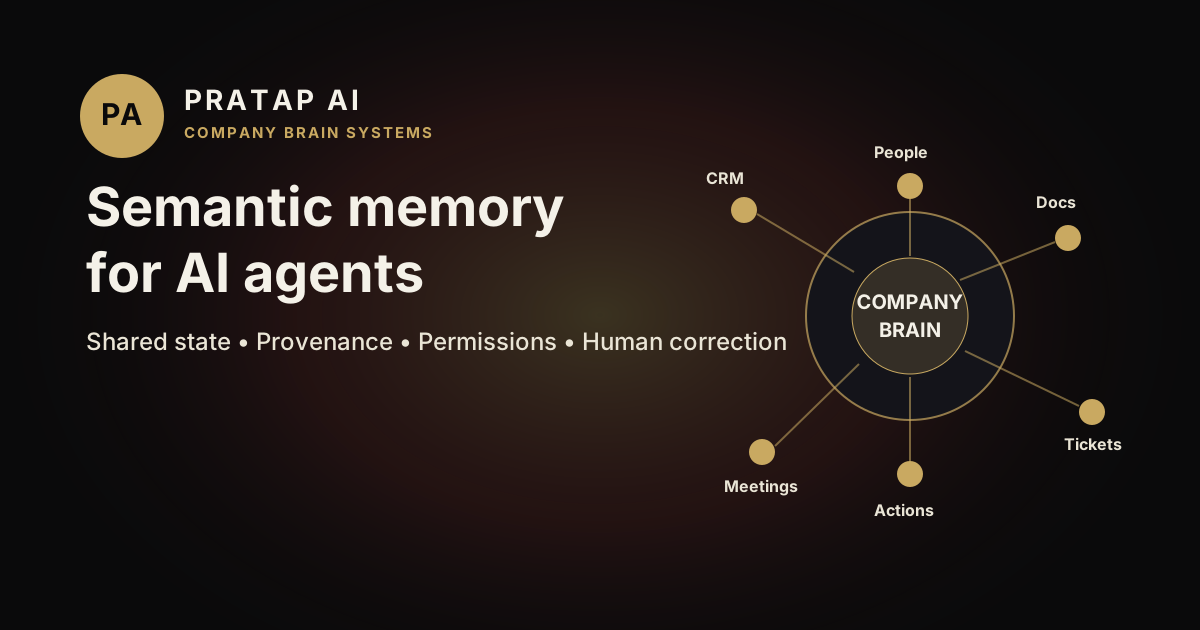
AI agent memory is useful, but it should not be treated as a source of truth. In business workflows, memory should provide context while live systems confi

Client Onboarding Checklist for Service Businesses: Build a First 30 Days That Creates Confidence
A practical client onboarding checklist for service businesses: capture context, confirm scope, assign owners, establish communication rules, and make the first 30 days visible.
WhatsApp Automation for Small Businesses: Start with Triage Before Full Autonomy
Learn the safest first step for WhatsApp automation in a small business: triage, routing, draft replies, and human approval before full autonomy.
AI Increases Output. Design the Review System First
AI can make a team produce more drafts, alerts, summaries, classifications, and suggested actions in a very short time. But that does not automatically increase business throughput. In many cases, it simply shifts the bottleneck into review. If people still ne
Stop Paying AI Agents to Do Deterministic Work
AI agents work best when deterministic workflow logic handles repeatable steps and models handle judgment. Learn how to design safer, cheaper, more reliable AI automation.

AI Agent Tool Access Audit: The Checklist Before Connecting Agents to Business Systems
Before connecting AI agents to Gmail, WhatsApp, HubSpot, Stripe, GitHub, or internal files, run this practical tool access audit to reduce operational risk.

Context Drift in AI Agents: The Quiet Failure Mode Businesses Need to Design Around
Context drift is when an AI agent loses track of the goal, source of truth, or decision boundary. Learn how to design safer AI workflows for business operations.
How to Safely Add Your First AI Agent to a Business Workflow
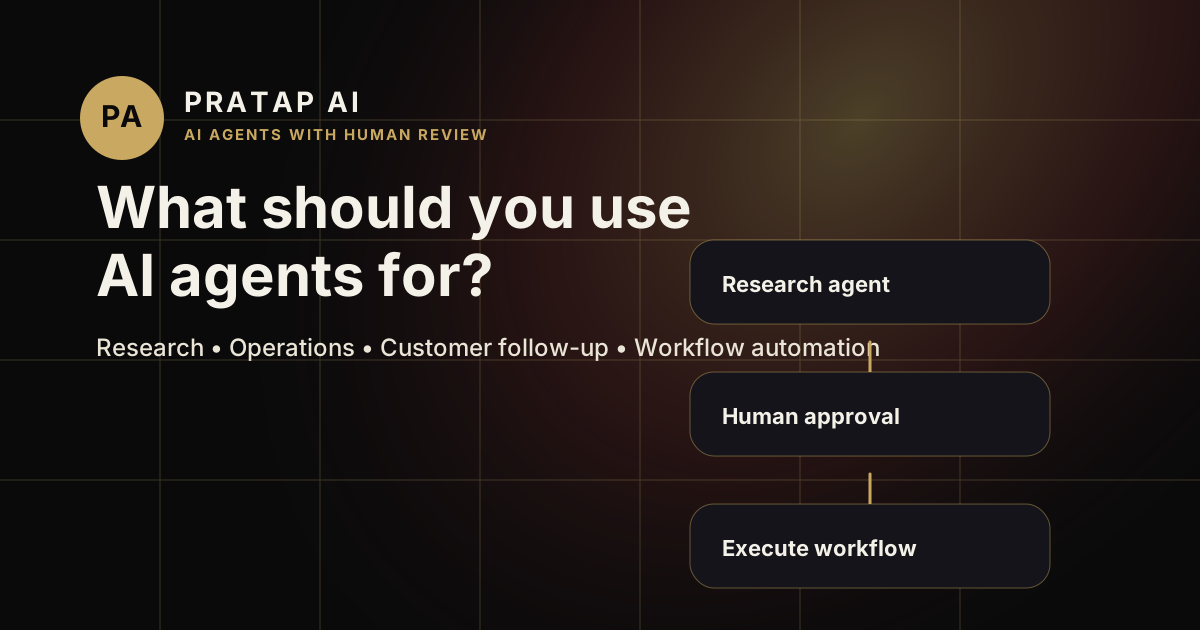
Learn how to choose a practical first AI agent, define permissions, add human approval points, and avoid turning automation into operational risk.

AI Readiness Checklist for Founders: 7 Workflows to Automate First
If you are considering AI for your business, the best starting point is usually not an autonomous agent. It is one repetitive workflow that is visible, mea

How I Cut My Blogging Time by 80% Using AI (And the Exact System You Can Steal)
I used to spend 15 hours on every blog post. Then I built an AI-powered system. Now I publish 3x more content in 3 hours. Here's the complete workflow.

The Rise of Voice Agents: Why Conversation Is Becoming the Next Business Interface
Voice agents are moving beyond simple assistants. Here is why AI-powered conversation is becoming a practical interface for sales, support, operations, and customer experience.

AI Workflow Audit Checklist for Small Businesses: What to Automate First
Use this practical AI workflow audit checklist to find where leads, customer context, and follow-up break down - then decide what to automate, review, or keep human.
Business Process Automation Checklist for Small Businesses: Start With One Workflow That Holds Up
A practical business process automation checklist for small businesses: choose one repeated workflow, define ownership and exceptions, automate safe steps, and improve it with real evidence.
AI Agent Approval Workflows: A Practical Guide for Small Businesses
A practical AI agent approval workflow helps small businesses use agents for useful internal work while keeping customer commitments, sensitive decisions, and exceptions with accountable people.

AI Agent Implementation for Small Business: 5 Workflows to Launch Safely
A practical guide to choosing a first AI-agent workflow, setting safe boundaries, assigning ownership, and improving operations without handing critical decisions to software.

Graph Engineering: How to Design AI Workflows That Scale With Control
A practical guide to graph engineering: map real dependencies, run independent work in parallel, use structured handoffs, and keep AI workflows governed by verification and accountable human review.

SOP Automation for Small Businesses: Turn Repeated Work Into a Reliable Workflow
A practical guide to SOP automation for small businesses: document one repeatable process, automate the safe steps, keep exceptions visible, and improve the workflow without burying judgment.

AI Automation ROI for Small Businesses: How to Measure One Workflow Before You Scale It
A practical AI automation ROI framework for small businesses: choose one workflow, establish a baseline, measure operational change, and decide whether to improve, scale, or stop.
Customer Handoff Process for Small Businesses: Keep Context, Ownership, and Next Actions Intact
A practical customer handoff process helps small businesses move a conversation between people or channels without losing context, ownership, or the next action.

Real Estate Lead Routing: A Practical System for Assigning, Confirming, and Recovering Inquiries
A real estate lead routing system turns calls, forms, and WhatsApp inquiries into owned next steps so promising buyers do not disappear between first contact and a site visit.
Company Operating System for Small Business: Turn Chats, Spreadsheets, and AI Tools Into Owned Work
A practical company operating system makes important work visible, owned, and reviewable - without forcing a small team into enterprise complexity.
Customer Support Triage Workflow for Small Businesses: A Practical System for Faster, Safer Replies
A practical customer support triage workflow for small businesses: capture requests, set urgency, assign ownership, use approved replies, and escalate sensitive issues safely.

AI Agent Harness: A Practical Guide to Safer, More Reliable Business Automation
An AI agent harness controls context, permissions, verification, memory, and safety. This expanded practical guide uses credited diagrams to show how dependable business automation is designed.

Open Knowledge Format: A Practical Way to Make Business Context AI-Ready
Google Cloud's Open Knowledge Format proposes a simple contract for sharing business context with people and AI agents. Here is what it means for teams building dependable AI workflows.

CRM Data Cleanup for Small Businesses: A Practical Reset Before You Automate
A useful CRM cleanup is not a spreadsheet exercise. It is a way to make customer context, ownership, and next actions trustworthy before a small business adds more automation.

WhatsApp Privacy Changes: A Practical Operating Model for Brands
AI Readiness Assessment for Small Business: 7 Questions to Answer Before You Automate
A practical AI readiness assessment for small businesses: seven questions that reveal whether a workflow is ready for automation—and what to fix first if it is not.

Appointment Reminder Automation for Clinics: A Practical System That Reduces No-Shows Without Sounding Robotic
A practical guide to clinic appointment reminder automation: what to send, when to send it, how to route replies, and where staff should stay involved.

How to Automate Quote Follow-Up for Service Businesses Without Chasing Every Lead
A quote follow-up workflow helps service businesses turn sent proposals into visible next actions without treating every prospect or every deal the same.

AI Agents Need Management, Not More Tokens
More AI capacity does not automatically create more business output. Reliable agents need a managed operating system: a clear job, the right context, measurable quality checks, and an owner for exceptions.
AI Escalation Matrix for Customer Messages: What to Automate, Review, and Keep Human
A practical AI escalation matrix helps small businesses automate routine customer messages without automating commitments, sensitive cases, or decisions that need human judgment.
How to Automate Customer Onboarding Without Losing the Human Touch
Customer onboarding automation works best when it removes coordination work without automating the promises, judgment, and relationship moments customers remember.

n8n for Small Business Automation: When It Fits and When It Does Not
n8n can connect the systems a small business already uses, but it is most useful when a team starts with one clear workflow, trusted data, and visible human ownership.

Clinic Appointment Scheduling Automation: A Safe System for Bookings and Human Handoffs
Clinic appointment scheduling automation works best when it makes booking requests visible, assigns clear ownership, and gives patients an easy route to a person for anything unusual.
CRM Automation for Small Businesses: Build a Follow-Up System That Does Not Lose Leads
CRM automation is not about adding more software. It is about turning every inquiry into visible, owned follow-up without losing the context that helps a team respond well.
AI Chatbot vs Workflow Automation for Small Business: What to Choose First
An AI chatbot can answer a question. A workflow can make sure the right person owns what happens next. Here is how small businesses can choose the right first AI investment.

Competitor Analysis for Small Businesses: Turn Research Into the Next Workflow
A practical guide to turning competitor analysis into one clear operating decision: what to clarify, what to fix, and which workflow to improve first.

When Is a Workflow Audit Better Than Buying Another Tool?
Before buying another automation, CRM, or AI tool, small teams should audit the workflow when ownership, handoffs, data quality, or follow-up rules are unclear.
WhatsApp CRM Integration for Small Business: Turn Chats Into Trackable Leads
A practical guide to WhatsApp CRM integration for small businesses: what to capture, what to automate, what should stay human, and how to avoid losing leads inside chat threads.

Lead Qualification Automation for Small Business: Separate Serious Buyers From Noise
A practical guide to lead qualification automation for small businesses: what to automate, what to keep human, and how to build a safe first-response workflow.
AI Automation Services for Small Businesses: What to Automate First, What to Keep Human
A practical buyer guide to AI automation services for small businesses: what they include, which workflows to automate first, and where human approval should stay.
Lead Source Tracking for Small Businesses: Stop Losing the Context Behind Every Inquiry
A practical guide to capturing where every inquiry came from, routing it to the right owner, and turning first response into accountable follow-up.
Clinic Missed-Call Automation Checklist
Clinic missed-call automation should start with a recovery loop: approved reply, booking context, callback task, owner queue, human escalation, and review.
Missed Call Automation Checklist for Small Businesses
A practical missed call automation checklist for turning unanswered calls into acknowledged, routed, and visible follow-up tasks.
First Response Gap Audit for Small Businesses
A first response gap audit shows where serious customer inquiries stall after a call, WhatsApp message, form, listing, or DM enters the business.
First Response Automation for Small Business: Turn New Leads Into Owned Follow-Up
First response automation helps small businesses turn new inquiries into owned follow-up by capturing context, routing work, and escalating sensitive cases to humans.
AI Receptionist Cost for Small Business: What You Actually Pay For
AI receptionist cost depends on the workflow you expect it to own: call volume, appointment intake, integrations, escalation rules, logs, review queues, and ongoing support.
Missed Call Automation for Small Businesses: Capture Leads Without Adding Staff
Missed call automation helps small businesses recover leads by sending fast follow-up, capturing context, creating callback tasks, and routing urgent cases to humans.
How to Automate a Small Business Without Hiring More People
Small businesses should not automate everything at once. Start with one repeated operating loop where the trigger, data, response, owner, escalation rule, and record are clear enough to trust.

AI Feasibility Framework for Founders
Research brief for: AI Feasibility Framework for Founders
Answer Engine Optimization: How to Make Your Content Visible to AI Search
A practical guide to answer engine optimization for teams that want their content cited in AI search, AI overviews, and chat-based discovery.