
Technician Visit Confirmation Workflow: Don't Dispatch Until the Customer Confirms
Treat a technician visit as unconfirmed until the customer replies. Use four job states, one clear message, and a named owner so techs do not leave base for a silent calendar slot.
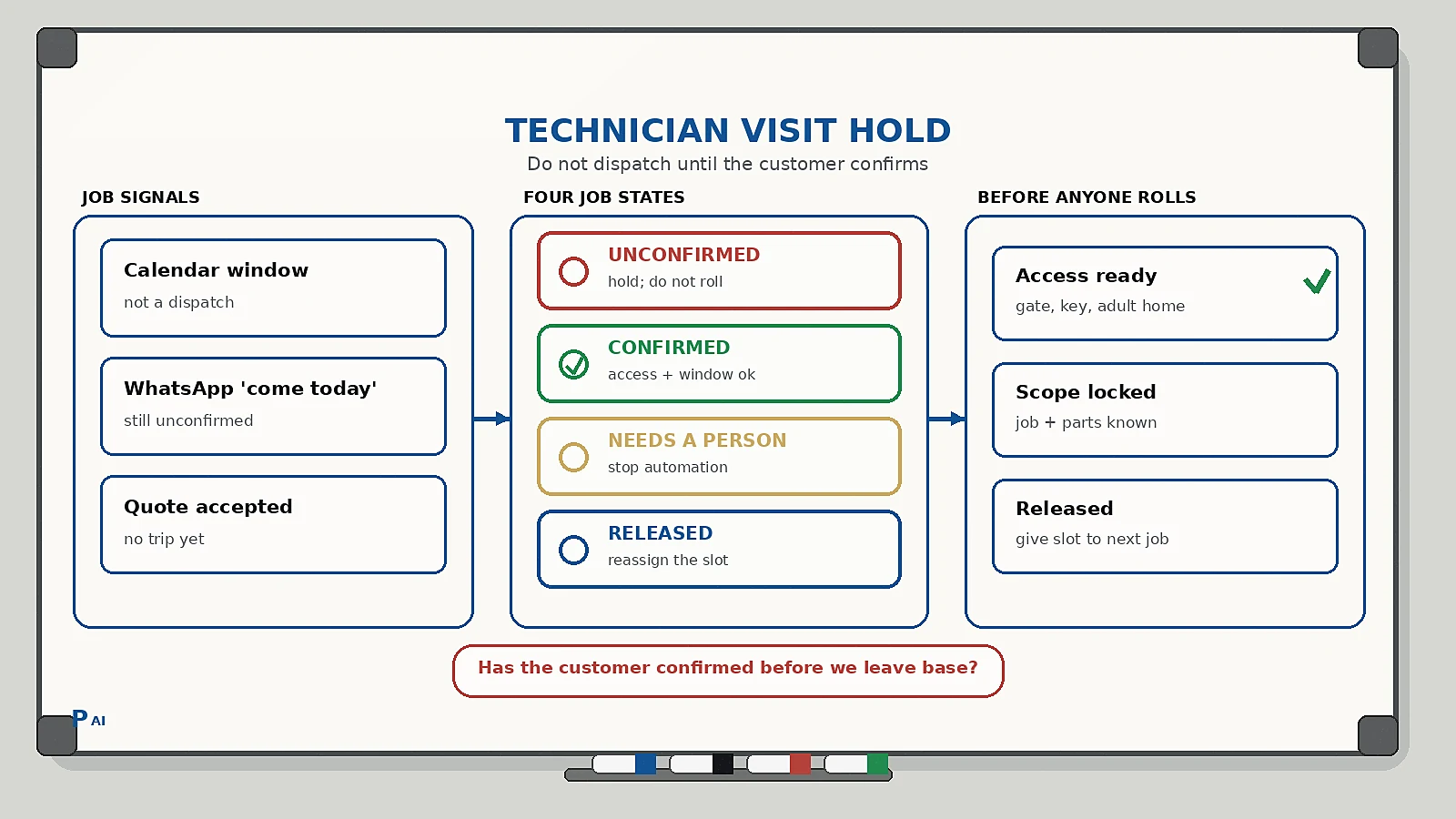
Quick answer
A technician visit confirmation workflow is the operating rule that holds a job until the customer confirms they will be there, the arrival window is usable, and the team can actually do the work. The workflow should do four things: tag the job as unconfirmed, send one clear confirmation request, retry once if there is no reply, and stop automation when access, scope, or parts change.
Do not treat a quote “ok,” a WhatsApp “come today,” or a calendar block as a dispatch. A technician visit is a trip with tools, parts, and a customer who must let someone in. Confirm the trip before a van leaves the base.
Why confirmation is an operations problem, not a dispatch feature
Most AC, plumbing, electrical, and appliance teams already know the pattern. The board looks full. The technician still leaves early to beat traffic. Nobody is home. The society will not open the gate. The spare the job needed is not on the van. The next paying job could have had that window.
The failure is not “we need more reminder templates.” The failure is missing ownership between booking and travel:
- Nobody named is allowed to hold or release the slot.
- The confirmation message also asks for a review, an upsell, and a photo dump.
- “Someone will be there” is treated as a confirmed arrival.
- Unconfirmed jobs occupy the same board as a locked emergency.
This is related to, but not the same as, quote follow-up. Quote follow-up decides whether the customer still wants the work. Confirmation decides whether anyone should roll. Clinics have a close cousin in appointment reminders. Real estate has one in site visit confirmation. Home service adds access codes, adult-at-home rules, parts on the van, and a scope that can change the moment a panel is opened.
The four states every technician job should have
Keep the states visible on the CRM, the WhatsApp inbox, and the technician’s day sheet. If the tech cannot see the state on the phone before starting the vehicle, the workflow is decorative.
| State | Meaning | What may happen next |
|---|---|---|
| Unconfirmed | Job created; customer has not verified date, window, address, and who will be home | Send the first confirmation request; do not treat the slot as locked for other jobs |
| Confirmed | Customer accepted the window, access, and the job you stated | Hold the slot; stop reminder retries; share prep notes and who is coming |
| Needs a person | Time change, no adult home, extra work, parts question, or “call me” | Named owner replies; automation stops |
| Released | Customer cancelled, or no usable reply after the retry window | Free the slot; give it to the next job that can use that zone and skill |
Two rules keep this honest:
- Confirmed facts and open questions stay separate. “Customer asked if 4–6 pm is possible” is not “job at 4 pm.”
- Only a named owner can move a job from Needs a person back to Confirmed.
This is the same design as a human-in-the-loop AI workflow: automation handles the routine path; a person owns judgement.
What the first confirmation message should contain
One message. One job. The customer should recognize the visit and answer without opening a brochure pack.
Include:
- Company name the customer already used.
- Service in their words (not an internal job code).
- Date and arrival window, in local phrasing (tomorrow 2–4 pm, not a raw timestamp).
- Address or tower and flat, as you have it on file, so they can correct it.
- Who should be present, if access depends on an adult or a society pass.
- One question: confirm, change the window, or cancel.
Do not mix this with a spare-parts catalogue, an AMC pitch, or a request for a Google review. Extra asks raise the chance the customer ignores the only question that protects the board.
A useful reply set is three options, not eight:
- Confirm
- Change time
- Cancel
Anything else — extra rooms, “also check the other AC,” “send the quote again,” society not allowing vendors, “who is this?” — should route to a person. If the same customer later repeats those details to a different dispatcher, you have a customer context handoff problem, not a reminder problem.
A practical sequence a small field team can run
Use clock time relative to travel, not a generic “24 hours before” for every job.
- At booking. Send the confirmation immediately. Same-day emergency jobs may only need this one message plus a last check before travel.
- If there is no reply. Retry once, closer to the visit. For a next-day afternoon window, a useful second touch is the evening before or the morning of, not another message five minutes later.
- If the customer confirms. Mark Confirmed. Stop retries. Then send the practical details that only matter after a yes: technician first name, what to keep clear, pets, water or power shutoff, parking.
- If the customer changes time, access, or scope. Move to Needs a person. A dispatcher checks skill, parts, zone, and travel time, then replies with a yes, a nearby window, or a decline. Automation does not invent a visit.
- If there is still no usable reply. Apply the house rule you already stated. For a packed Saturday AC round, that often means Released in time to offer the slot. For a quiet weekday nearby job, holding until the last hour may be cheaper than chasing.
Name the owner before the day starts. “Whoever is on WhatsApp” is not an owner. The dispatcher for that zone, or the technician assigned to that skill, is.
The hard rule: do not start the drive while the job is still Unconfirmed, unless a person explicitly accepts the risk. Confirmation is cheap. An empty technician visit is not.
Access, parts, and scope are part of confirmation
A restaurant can sometimes fill a released table from a waitlist in the room. A technician visit usually cannot. Someone else is already moving:
- A customer who took time off work.
- Security who needs a name and vehicle number.
- A second technician who was going to handle overflow.
- Parts that were pulled from stock for this job, not the next one.
When the job is Confirmed, send the technician a short internal note: address, window, access, parts, and the job as the customer described it. When it moves to Released, tell them immediately. Leaving a tech at a locked gate is how you lose the afternoon, not just one ticket.
Do not put the technician’s personal number in the first customer message unless that is an explicit house rule. The confirmation channel is for the job. Internal coordination stays internal.
An “en route” ping is useful after confirmation, not instead of it. GPS updates do not fix a diary that was fiction before the van moved.
Slot fill is part of confirmation, not a separate campaign
A confirmation workflow that never frees a slot is only half-built. When a job moves to Released, the next action should already exist:
- Who is next for that zone, skill, and time window.
- What message they get (one offer, one expiry).
- How long they have to accept before the offer moves on.
- Who may give the slot to a walk-in or a nearby callback.
Do not blast every lead who ever asked for an AC service. That creates three “yes” replies for one technician and a new operations mess. Offer in order. Expire the offer. Then move to the next name.
If the original demand arrived as a missed call, the callback still has to land in an owned queue — see missed call automation for small businesses — but the visit state lives on the board, not in the call recording. WhatsApp chats that never become a job record are a WhatsApp-to-CRM problem sitting underneath confirmation.
What should never be automated
Keep these with a person, even if the first message was automatic:
- Price, discount, or “lowest you can do” replies.
- Extra work found after opening a unit, wall, or panel.
- Parts that change the quote or the same-day promise.
- Access problems: no adult home, society refusal, missing keys.
- Safety issues: gas, water leak, electrical smell, locked pets.
- Angry or confused replies, including “I already cancelled.”
- Any request that would steal another customer’s window.
Voice still matters when the customer will not type. A call still has to update the same four states. Otherwise the next technician will trust a silent calendar.
How to know the workflow is working
Do not start with a revenue dashboard. Start with states a dispatcher can count at the end of the day:
- Share of jobs that reached Confirmed before the technician left.
- Share still Unconfirmed at the travel cutoff.
- How often Needs a person waited more than 15 minutes for a reply.
- How many Released slots were offered to the next job in time to use the zone.
- How often a “confirmed” visit failed because access or parts were never checked.
If unconfirmed weekend jobs still fill the board, the messages are not the bottleneck. The hold rule is.
Implementation checklist
- Every technician visit has one of four states on a surface the tech can see before travel.
- The first message states service, window, address, and three reply options.
- Retries stop after one follow-up or after the customer confirms.
- Time changes, access issues, pricing, extra scope, and complaints route to a named person.
- Released slots have a next-job offer order and an expiry.
- Access, parts, and technician notes update when the state changes.
- Context from WhatsApp, phone, and the CRM stays with the job, not in a private chat.
FAQ
Should every home-service team confirm every visit?
No. A two-minute walk from a society office to a known AMC unit on a quiet Tuesday may not justify a chase. Use confirmation where a no-show actually costs travel, parts pulled from stock, or a slot another customer wanted: weekend rounds, far jobs, gated societies, and days that already turn other work away.
Is WhatsApp required?
No. Use the channel customers already reply on. WhatsApp is common for field teams in India and many other markets, but SMS or a short call can carry the same four states. The channel is not the workflow.
When should we call instead of messaging?
When there is no usable reply before the travel cutoff, when the customer asked to be called, or when access depends on a person who will not read a chat in time. A call still has to update the same four states.
What if the customer confirms and still is not home?
That is a no-show after confirmation, not a failed reminder. Apply the wait window you stated, offer the slot if you still can, and record the outcome on the customer record so the next visit is not treated as a first-time unknown.
If you want this designed as a live field workflow — states, message copy, next-job order, and the human exception path — contact Pratap AI Innovations. We implement WhatsApp and voice automation for home-service, real estate, and clinic teams that need the diary to stay honest before anyone travels.