AI Receptionist vs Missed-Call Text-Back: What to Start With
Compare an AI receptionist, missed-call text-back, and an answering service. See which job each one owns, what must stay human, and how to keep one customer record.
Quick answer
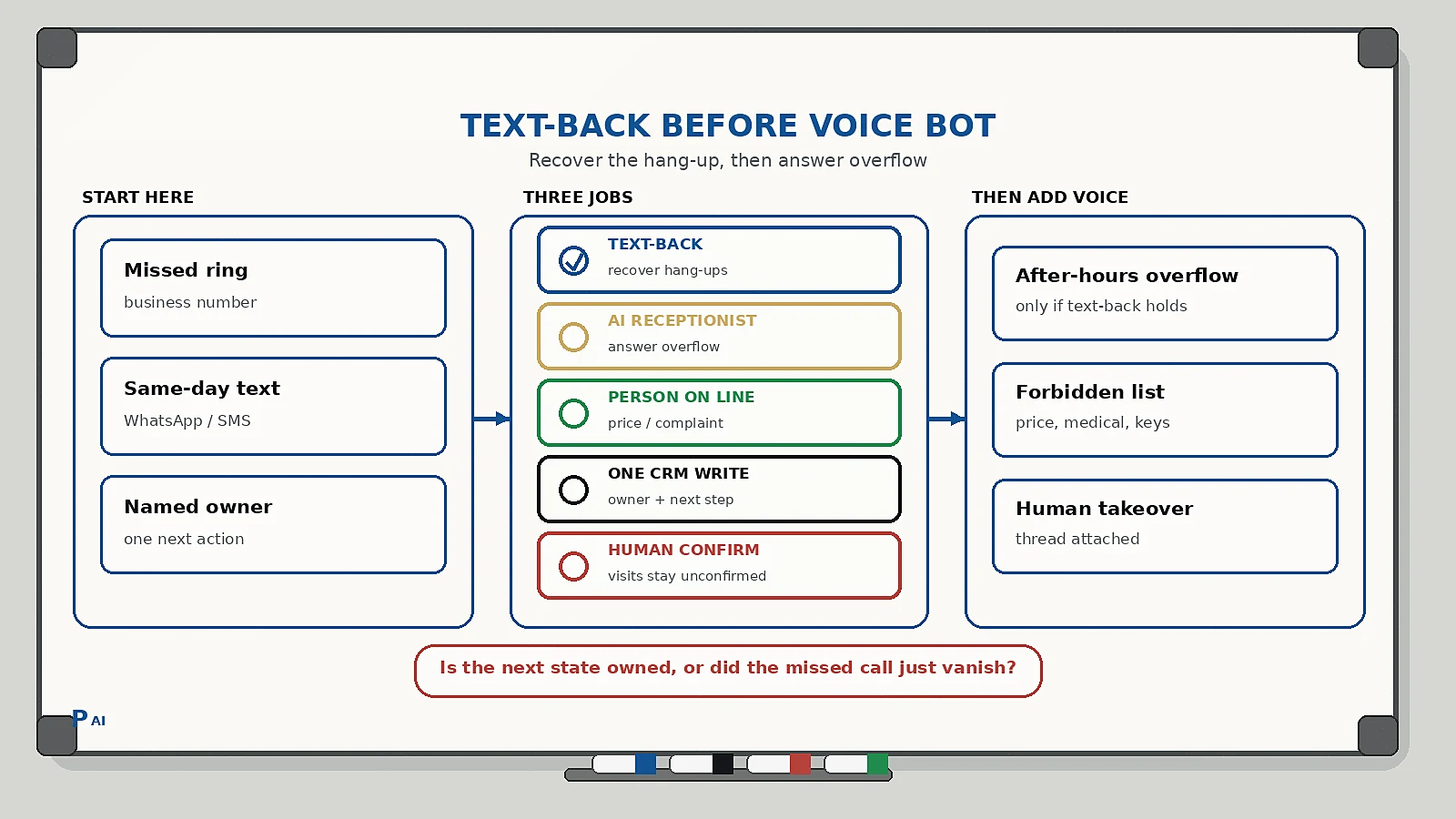
Missed-call text-back recovers people you already failed to answer. An AI receptionist tries to answer the call itself. An answering service puts a person on the line. Most small teams should start with text-back plus a named owner and a CRM write, then add AI answering for overflow and after-hours only if the first workflow already holds.
The problem is not "nobody answered"
The problem is the next state is invisible: no owner, no record, no allowed reply. Voicemail is not a workflow. A missed call without a recovery path is a lead that evaporates.
Founders often ask "Do I need an AI receptionist?" when the real question is: what happens to every inbound call right now? If the answer is "sometimes voicemail, sometimes nothing, and I don't know who follows up," then an AI receptionist is not the first fix -- a recovery workflow is.
What each option actually does
Missed-call text-back
After a no-answer, the system sends an SMS or WhatsApp message from the business number (not the founder's personal chat). The message acknowledges the call, captures the reply, and assigns a named owner in the CRM. The job is recovery -- not conversation.
AI receptionist
Answers the live call, can take a message, ask routine questions, and escalate. It does not replace judgement on price, access, medical, legal, or complaints. The job is live answering with guardrails.
Answering service / virtual receptionist
A person takes the call from a script. Useful for high-emotion or high-stakes conversations; weak if notes never reach the CRM. The job is human coverage when the team cannot pick up.
Comparison: which job does each own?
| Job | Text-back | AI receptionist | Answering service |
|---|---|---|---|
| Answers the ringing phone | No | Yes | Yes |
| Recovers a hang-up | Yes | Only if it also texts | Rarely |
| Books / confirms without a person | Should not, unless slot rules are strict | Only for low-risk, rule-based slots | Sometimes |
| Writes CRM with owner + next action | Must | Must | Often missing |
| After-hours | Good first layer | Good overflow layer | Paid coverage |
| Typical failure | Text with no owner | Books the wrong thing | Notes in email, not the record |
Do not fill the table with unverified prices or conversion rates. The decision is operating fit, not the lowest sticker.
What should stay human-owned
| Area | Why it stays human |
|---|---|
| Pricing & promises | Bots cannot negotiate or make commitments |
| Complaints & escalations | Emotion needs a person, not a script |
| Medical / legal / safety | Liability and ethics require human judgement |
| Access / keys / dispatch | Physical actions need verified confirmation |
| Anything the diary must not treat as confirmed until a person says so | Unconfirmed bookings create operational chaos |
Start-here workflow (do this first)
- Count missed calls for two weeks -- split day vs. after-hours. No invented industry averages.
- Turn on text-back / WhatsApp from the business number -- not the founder's personal chat.
- Create or update one record: source, time, owner, next action.
- Allow only a short acknowledgement plus "a person will confirm."
- Escalate: price, complaint, urgent dispatch, medical, or "talk to a person."
- Add AI answering only for overflow/after-hours once steps 2-5 already work.
- Weekly review: unanswered texts, duplicate records, bookings that were never confirmed.
India / WhatsApp note
Callers often continue on WhatsApp. A text-back that dies in SMS while sales lives in WhatsApp is a split brain. Route the recovery thread to the same owned record as the call. The CRM entry must capture the channel, the owner, and the next action -- regardless of whether the reply came via SMS or WhatsApp.
How to evaluate a vendor (five questions)
Ask these before you sign:
- Where does the record live after the call or text?
- Who is the named owner if the bot is unsure?
- What is the bot forbidden to say or book?
- How does a human take over with context?
- Who maintains hours, scripts, and exceptions after week one?
If a vendor cannot answer all five clearly, they are selling a demo -- not a workflow.
Implementation checklist
- Business number, not personal
- Day vs after-hours routing
- Text / WhatsApp recovery template
- Required fields: name, number, intent, owner, next action
- Confirmation vs unconfirmed state
- Exception list (price, complaints, medical, dispatch)
- Audit log / recording policy as applicable
- Weekly miss review
FAQ
What is missed-call text-back?
An automated SMS or WhatsApp message sent from your business number after a call goes unanswered. It acknowledges the caller, captures their reply, and creates a CRM task with a named owner.
Do I need an AI receptionist if I already text missed callers?
Only if you have volume that text-back cannot handle -- e.g., callers who need to speak to someone live, or after-hours coverage where text-back alone misses urgency. Add AI answering as an overflow layer, not the first layer.
AI receptionist vs answering service -- which is cheaper?
Public 2026 ranges vary widely by vendor and country. Do not quote Pratap fees. The decision is operating fit, not the lowest sticker. Point to the cost article for benchmarks; choose based on who owns the record and the exception path.
Can an AI receptionist book appointments on its own?
Only for low-risk, rule-based slots (e.g., "book a 15-min discovery call"). It should not book anything involving price, access, medical triage, or legal commitment without a human confirmation step.
Where should WhatsApp fit?
WhatsApp is the primary recovery channel in India and much of South Asia. The text-back should send WhatsApp first (if the business number is WhatsApp-enabled), then SMS as fallback. The reply -- wherever it lands -- must route to the same CRM record.
What should a small business start with this week?
Turn on missed-call text-back from the business number. Assign one owner per inbound path. Write every interaction to the CRM with a next action. Measure for two weeks. Then decide if you need AI answering.
Practical takeaway
The first inbound-call workflow is not "answer every call." It is recover every miss, write one record, assign one owner. Start with text-back + CRM + named owner. Add AI answering for overflow only when the recovery loop already holds.
If you want to map your inbound paths -- missed call -> recovery message -> owner -> record -> confirmation -- start a conversation. No pitch, no price talk -- just the audit.