After-Hours Voice + WhatsApp: The Booking Recovery Workflow for Clinics and Hospitality
Voice answers the night call and holds the slot. WhatsApp confirms and reminds on the same record. The front desk walks in to a clean board — not a voicemail pile.
Clinics and restaurants do not lose after-hours bookings because the team is lazy. They lose them because the phone still rings when nobody is at the desk, and the next morning there is no shared record of what was asked.
This is not the same problem as a daytime missed-call text-back, and it is not the same as a clinic reminder sequence for appointments that are already on the book. The job here is: answer, hold, confirm, remind — on one diary.
Quick answer
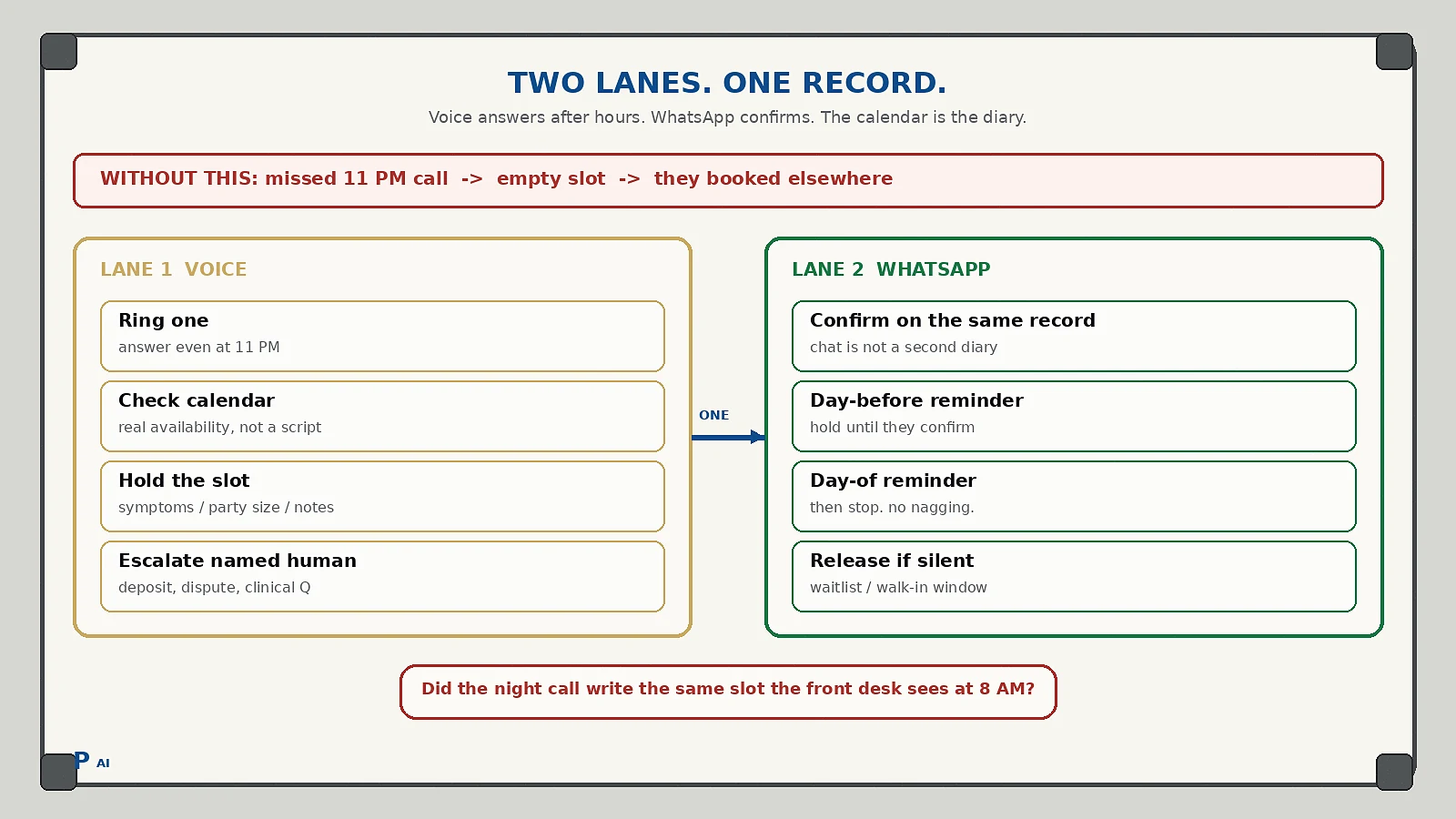
Voice answers on the first ring, checks a live calendar, and holds the slot with context (symptoms, party size, notes). WhatsApp then sends confirmation and day-before / day-of reminders on that same record. A named person only handles deposits, disputes, clinical questions, and high-value bookings.
The leak is coverage, not headcount
Hiring another receptionist does not cover the 11 PM call. Industry write-ups on clinic operations often put unanswered after-hours inbound in a high range; hospitality operators report a large share of peak-hour calls going unanswered. Treat those as directional context, not a Pratap-measured result.
The patient or guest who does not get through books elsewhere. The table or chair stays empty. The diary never knew they called.
Two lanes, one record
The fix is not one chatbot. It is two lanes that converge.
Lane 1 — Voice
- Answers even after close
- Checks real availability, not a scripted “we will call you back”
- Holds the slot with context
- Escalates a named human for deposits, disputes, clinical questions, VIP or high-value bookings
Lane 2 — WhatsApp
- Writes confirmation to the same calendar / CRM row
- Fires day-before and day-of reminders in the channel they already use
- Stops if they stay silent (no nagging)
- Releases the slot on a defined window so waitlist or walk-in can use it
The shared record is what the receptionist or host opens at 8 AM. Chat is not a second diary. Voicemail is not a diary.
This is the same “one record” rule as WhatsApp appointment cancellation and reschedule: the calendar is source of truth.
Clinic walk-through
11 PM call → voice answers → “Dr. Sharma has 9 AM tomorrow — want it?” → patient says yes → slot held on the clinic calendar → WhatsApp confirmation → 8 AM reminder → front desk sees a booked slot, not a voicemail.
Humans still own: new-patient deposits, walk-in conflicts, “is this urgent?”, treatment-plan conversations.
If you already run clinic appointment reminders, keep that sequence. This article is the night-call capture that creates the appointment those reminders protect.
Restaurant walk-through
Friday 7 PM rush → voice answers → “table for 4 at 8:30?” → guest says yes → table held → WhatsApp confirm + 7 PM reminder → host sees a reserved table, not a missed-call list.
Humans still own: large-party deposits, walk-in conflicts, allergies / accessibility, VIP guests.
Multi-location
Central voice number, per-location calendar, local WhatsApp templates. Voice checks the right site. Each manager sees their own board. Do not dump every city into one chat thread.
What the human still owns
| Human | Automation |
|---|---|
| Deposits and payments | Answer on ring one |
| Walk-in conflicts | Calendar check and hold |
| High-value / VIP | Confirmation message |
| Clinical or nuanced questions | Day-before reminder |
| Disputes | Day-of reminder, then stop |
A six-step audit before you buy another tool
- Capture — call, WhatsApp, web, form land in one record with a timestamp?
- First response — first reply has who / what / when?
- Callback — missed calls return after hours, not only in the morning pile?
- Confirmation — one calendar, customer gets a channel they already use?
- Reminder — day-before and day-of fire, then stop?
- Next step — every outcome has a date, owner, and next action?
Score yourself honestly. The step that is easy for a competitor and hard for you is the first workflow to fix.
Common questions
How do voice and WhatsApp work together after hours?
Voice answers, checks the calendar, and holds the slot. WhatsApp confirms and reminds on the same record. The morning board should match the night call.
Do I need the WhatsApp Business API?
For reliable template reminders at scale, yes — through an approved business solution provider. The workflow sits on templates you own, not a random personal number.
What if they do not reply to the reminder?
Stop. Do not nag. Release the slot on a defined window. Notify a named person so waitlist or walk-in can use the hour.
Can this run multi-location clinics or restaurant groups?
Yes, if each location has its own calendar and templates. Central answering without local diaries creates the same mess you have today.
How is this different from a virtual receptionist?
A virtual receptionist is another person on the line. This is a workflow: voice with calendar context, WhatsApp on the same record, a named human only on exceptions. You own the logic and the data.
How is this different from after-hours WhatsApp auto-reply?
After-hours WhatsApp auto-reply recovers a chat you already missed. This article is for the phone that still rings after close, then uses WhatsApp to lock the booking you just held.
The after-hours call you miss is the patient or guest you never meet. Two lanes — voice for the answer, WhatsApp for confirm and remind — one shared record. If that board is still empty at 8 AM, map the night funnel first. Talk to us.