Local-First Founder OS: Why Owning Your Company Data Beats Scaling Another SaaS
A local-first founder OS keeps your company's core data owned and recoverable instead of locked inside a growing stack of subscriptions. For most founders, this is a control decision, not a complexity decision.
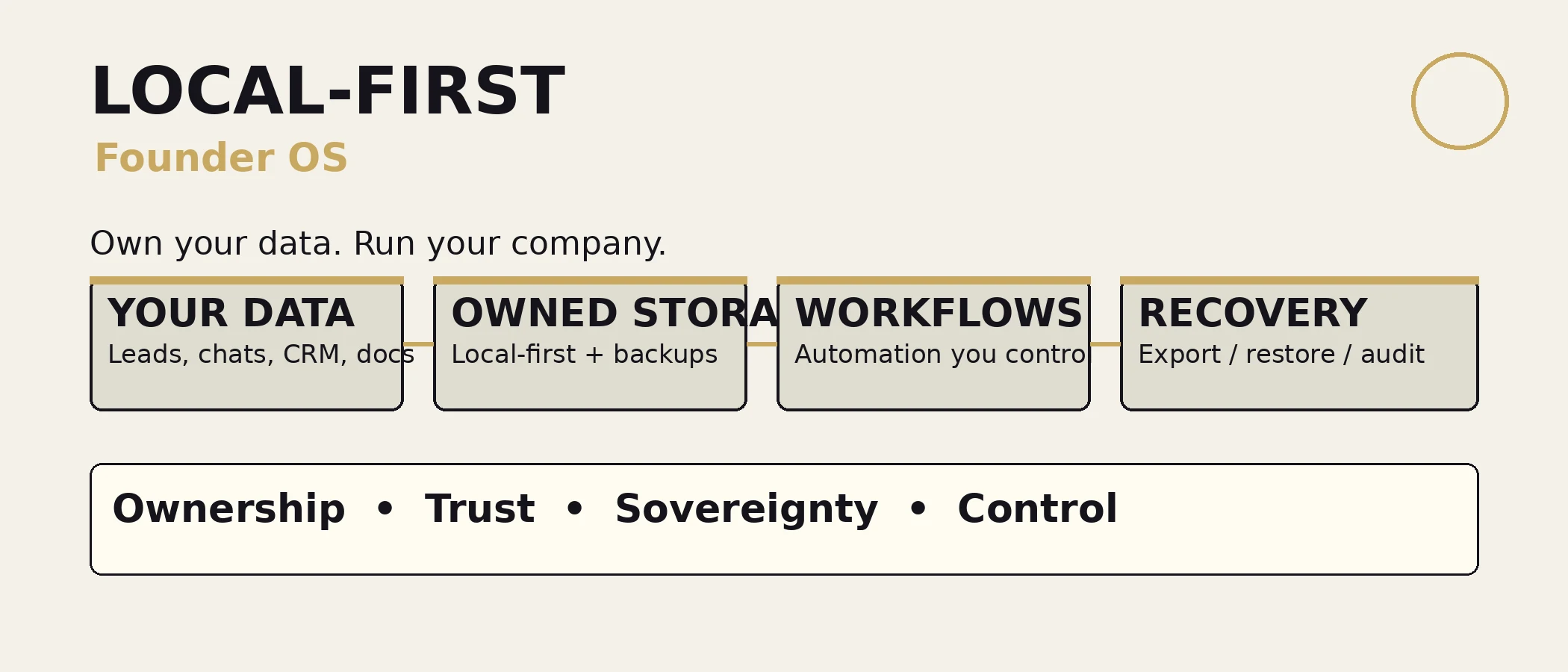
A local-first founder OS keeps your company's core data - leads, chats, CRM, contracts, documents - owned and recoverable instead of locked inside a growing stack of subscriptions. For most founders, this is a control decision, not a complexity decision.
Every company runs on its operational data: who your customers are, what was said, what was promised, what is owed, and what happens next. When that data is scattered across half a dozen SaaS tools, you do not really own your company's operating memory - you rent fragments of it, and you depend on each vendor to keep it accessible, exportable, and recoverable.
The case for local-first is straightforward: own the source of truth, replicate it safely, and keep the ability to move or restore it. You do not need to run a data center to achieve this. A solo founder or a mid-size team can run a disciplined local-first stack on a modest laptop plus encrypted backups.
What "local-first" actually means for a business
Local-first does not mean working offline forever or rejecting cloud tools. It means the authoritative copy of your important data lives somewhere you control - a local database or a self-hosted service - and the cloud is used for sync and recovery rather than as the only home for the data.
For a small operation, the practical test is not "which tool is local." It is: if a vendor disappeared tomorrow, how much of your operational history could you restore, and how quickly? A local-first setup is one where the answer is: essentially all of it, in a format you can read and move.
This matters for confidence as well as continuity. When a lead conversation, a signed agreement, or a customer record is in a file you can open, your team can act on it without reconstructing context from memory. The company os stays intact even as tools and people change.
What a local-first founder OS actually needs
| Layer | What it holds | Why it matters |
|---|---|---|
| Core data | Contacts, leads, deals, CRM records | The operating truth of the business |
| Context | Chats, notes, call outcomes, history | Everything needed to act without re-asking |
| Workflows | Automations, routing, follow-up rules | The process your team depends on |
| Assets | Documents, contracts, exports | The legal and commercial record |
| Recovery | Backups, restores, audit trail | Proof it can be recovered and who did what |
The point of a functional founder OS is not maximum automation. It is that each layer has a clear source of truth, a named owner, and a recovery path.
The five decisions that make data ownable
- Decide which records are the source of truth. For most service businesses this is the CRM and the on-file documents; everything else can reference it.
- Choose storage that you control. A local database or self-hosted service beats a web account with no export story.
- Encrypt and back up on a schedule. Local data is only safe if it is regularly copied off the device.
- Define an export and restore procedure. If you cannot restore, you have not actually kept control.
- Review ownership once a quarter. Data that is never checked drifts toward being lost or vendor-locked.
When local-first is overkill, and when it is essential
For a single operator or small team, starting simple with one owned source of truth (the CRM or a document store) and a solid backup routine is the right first step. You do not need to self-host every tool to be local-first; you need to control the few records that your business cannot afford to lose.
It becomes essential the moment the data is sensitive, high-stakes, or hard to rebuild: client agreements, payment history, health or legal records, and multi-year customer context. In those cases, renting the only copy is the real risk, not maintaining it.
How this connects to choosing an AI operations partner
If you bring in help to build workflows and automation, a local-first principle changes what you should ask for. The right partner designs the automation so your data stays the source of truth and the workflow can be exported, audited, and moved if you change systems. Some providers will try to hold your process inside their own platform; that is a lock-in cost even when the monthly price looks low.
Ask three questions before any implementation: Where does my data live? Can I export and restore it myself? And who owns the process after launch? If the answer to any of them is "only inside the vendor," you are renting rather than owning your operating system.
Practical takeaway
Pick the one record your business could not function without, find where its authoritative copy lives today, and make sure you can export and restore it this week. That single act moves you from renting your company's memory to owning it.