First Response Automation for Small Business: Turn New Leads Into Owned Follow-Up
First response automation helps small businesses turn new inquiries into owned follow-up by capturing context, routing work, and escalating sensitive cases to humans.
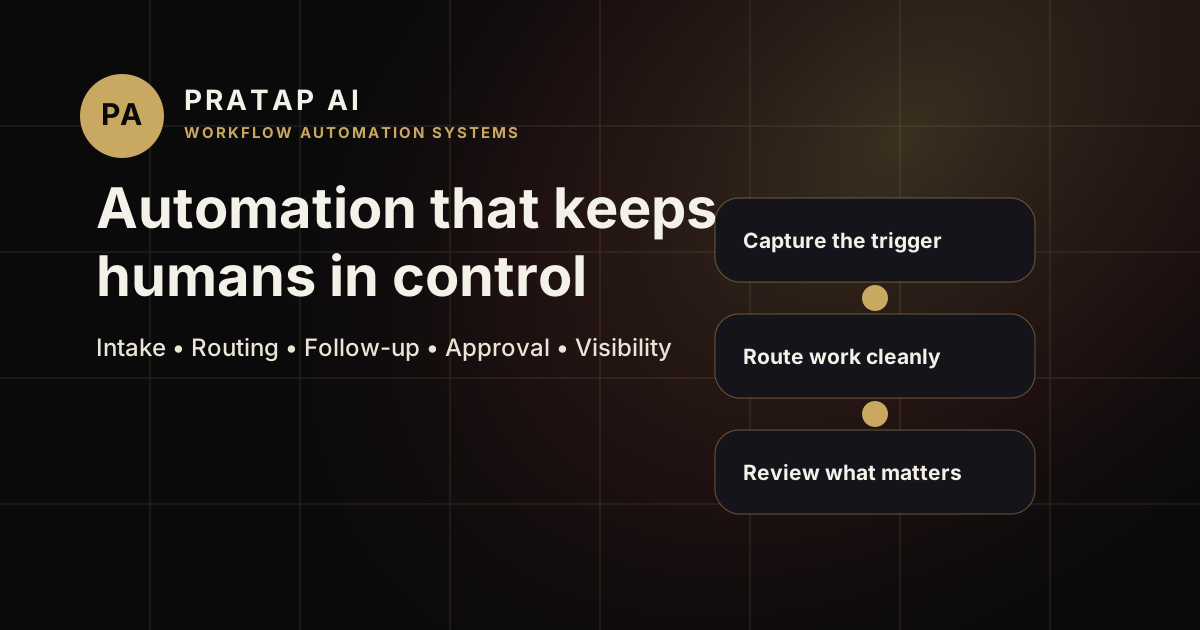
Quick answer: first response automation is the workflow that captures a new inquiry, replies with a useful first message, records the context, assigns an owner, and creates the next follow-up step. For a small business, the goal is not to replace the team. The goal is to stop new leads from disappearing inside missed calls, WhatsApp chats, inboxes, spreadsheets, and staff memory.
A fast first response is useful only when it creates ownership. If a customer receives a polite auto-reply but nobody knows who should call back, what they asked for, or whether the case is urgent, the business has not solved the real problem. It has only added a message.
The practical version is narrower and more reliable: build one response loop that takes every new inquiry from “someone reached out” to “the right person has a clear next step.”
Why small businesses lose leads after the first inquiry
Most lead leakage is not caused by a lack of effort. It usually comes from a weak handoff system.
A founder, receptionist, sales executive, or support team may be trying to respond quickly, but the work is spread across too many places:
- phone calls and missed calls
- WhatsApp messages
- Instagram or website inquiries
- email threads
- spreadsheet rows
- CRM records that are updated later, if at all
- verbal reminders between team members
This creates a gap between the first customer signal and the next owned action. The customer may have shown buying intent, but the business still has to answer several operational questions:
- What did they ask for?
- How urgent is it?
- Are they a new lead, returning customer, patient, guest, buyer, or support case?
- Who owns the next step?
- Should the reply be automatic, human, or both?
- When should someone follow up if there is no response?
- Where should the conversation be logged?
First response automation works when it answers those questions consistently.
What first response automation should include
A useful first response system has five parts.
1. Capture the lead source
Start by identifying where the inquiry came from. This matters because the right response differs by channel.
A missed phone call may need a callback task and WhatsApp message. A website form may need lead qualification. A clinic inquiry may need appointment options and human escalation. A real estate inquiry may need project interest, budget, location, and site-visit timing.
Do not treat every inquiry as the same generic lead. Capture the source and intent early.
2. Send a helpful first reply
The first reply should do more than say “we will get back to you.” It should reduce uncertainty and collect the next useful detail.
Examples:
- “Thanks for reaching out. Are you looking for pricing, availability, or a callback?”
- “Sorry we missed your call. Please share your preferred time and we will route this to the right person.”
- “To help the team respond faster, can you confirm the service/location/order number?”
Keep the message short. The goal is not to run the whole conversation automatically. The goal is to create a clean next step.
3. Create a record
If the inquiry does not create a record, the team is still depending on memory.
The record can live in a CRM, spreadsheet, helpdesk, calendar, or internal dashboard. What matters is that it includes the minimum useful context:
- customer name or contact
- channel
- inquiry type
- urgency
- requested service or product
- assigned owner
- next follow-up time
- status
This is where many chatbot-style automations fall short. They can reply, but they do not always create operational visibility.
4. Assign an owner
A lead without an owner is not a lead workflow. It is just information.
Assign ownership based on simple rules first:
- location or branch
- product or service line
- urgency
- new inquiry versus existing customer
- sales versus support
- language or preferred channel
- high-value or sensitive cases
The owner should know what happened, what the customer wants, and what to do next. Automation should remove the coordination burden, not create another place to check.
5. Escalate what should stay human
Small businesses should be careful with full autonomy in high-trust conversations. Automation can handle routine intake, reminders, summaries, and routing. Humans should still own judgment-heavy moments.
Escalate cases such as:
- angry or distressed customers
- medical, legal, financial, or safety-sensitive questions
- refund or payment disputes
- VIP or high-value opportunities
- unclear intent
- repeated failed contact attempts
- anything outside approved answer boundaries
This is the human-in-the-loop part of the system. It lets the business move faster without pretending every conversation should be automated end to end.
A simple first response workflow
Here is a practical starting workflow for a founder-led business:
- A customer calls, messages, or fills a form.
- The system identifies the channel and inquiry type.
- The customer receives a short, useful acknowledgement.
- The system asks for one missing detail if needed.
- A record is created in the CRM, sheet, or dashboard.
- The inquiry is assigned to the right person.
- The owner receives a task with context and due time.
- If the customer does not respond, a follow-up reminder is triggered.
- Sensitive or unclear cases are escalated to a human.
- The founder or manager can review open inquiries in one place.
This workflow is intentionally simple. It gives the business a reliable operating loop before adding more advanced AI.
Examples by industry
Clinics and appointment-led businesses
A clinic may use first response automation to capture appointment intent, preferred time, patient type, and urgency. Routine appointment questions can receive approved responses. Sensitive symptoms, complaints, and medical judgment should escalate to staff.
Useful first workflow: missed call → WhatsApp acknowledgement → appointment intent → staff callback task → daily open inquiry review.
Real estate teams
A real estate team may use automation to capture project interest, location, budget range, timeline, and site-visit preference. The system can route serious buyers to the right sales owner and create reminders for site-visit follow-up.
Useful first workflow: inquiry → qualification questions → assigned sales owner → site-visit task → follow-up reminder.
Ecommerce and D2C brands
An ecommerce team may use first response automation to separate order status, delivery issues, product questions, refund requests, and new purchase inquiries. Routine tracking questions can be answered automatically when the data is available. Refund exceptions and angry customers should escalate.
Useful first workflow: WhatsApp message → order/support category → record update → approved response or human handoff → unresolved queue.
Hospitality and local services
A hotel, salon, event venue, or service business may use first response automation to capture availability, date, location, group size, and callback preference. The system can prevent good inquiries from being buried during busy hours.
Useful first workflow: inquiry → required booking details → owner assignment → calendar or callback task → follow-up if no reply.
What to automate first
Start with the highest-leakage, lowest-risk loop. For many small businesses, that is one of these:
- missed-call recovery
- WhatsApp inquiry acknowledgement
- website lead form routing
- appointment request intake
- quote request intake
- callback task creation
- repeated FAQ triage
- open lead review dashboard
Avoid starting with the most complex customer conversation. The first automation should prove that the business can capture, route, and review work reliably.
What not to automate first
Do not begin with conversations where the cost of a wrong answer is high or the information is incomplete.
Avoid fully automating:
- pricing negotiation
- medical advice
- legal or compliance questions
- refund disputes
- angry customer handling
- high-value sales judgment
- custom promises the business cannot verify
These moments need clear human ownership. Automation can still help by summarizing the case, collecting context, and routing it quickly.
How to measure whether the system is working
A first response automation system should be measured by operational clarity, not only message volume.
Track practical indicators such as:
- number of new inquiries captured
- number of missed calls recovered
- percentage of inquiries with an assigned owner
- open inquiries without next step
- average time to first useful response
- follow-ups due today
- escalated cases awaiting human review
- leads closed as qualified, unqualified, booked, or resolved
The most important question is simple: can the owner see every active inquiry and who is responsible for the next action?
Implementation checklist
Before buying or building a first response automation system, define the operating rules.
- List every channel where new inquiries arrive.
- Pick one channel to automate first.
- Define the first message customers should receive.
- Decide the minimum details to capture.
- Choose where the record should live.
- Define owner assignment rules.
- Define escalation rules.
- Create the follow-up timing.
- Build a simple open-inquiry dashboard.
- Review the workflow weekly and adjust the rules.
This checklist prevents the business from buying a tool before understanding the workflow.
Common mistakes
Automating replies without ownership
A reply is not a workflow. If the customer gets a message but nobody owns the next step, the leak remains.
Asking too many questions upfront
Long intake flows reduce response. Ask for the one or two details needed to route the case correctly.
Treating all leads equally
Urgent, high-value, repeat-customer, and support cases need different routing rules.
Hiding the workflow from managers
If the owner cannot see open inquiries, overdue follow-ups, and escalations, the system will drift back into manual chasing.
Removing humans too early
The safest automation keeps humans in the loop for judgment-heavy work while removing repetitive coordination.
FAQs
What is first response automation?
First response automation is a workflow that sends an initial reply to a new inquiry, captures basic context, creates a record, assigns an owner, and triggers the next follow-up step.
Is first response automation the same as a chatbot?
No. A chatbot may only answer messages. First response automation focuses on the operating workflow: capture, routing, ownership, follow-up, escalation, and visibility.
What should a small business automate first?
Most small businesses should start with a narrow, high-leakage workflow such as missed-call recovery, WhatsApp inquiry acknowledgement, website lead routing, appointment intake, or callback task creation.
Can first response automation work with WhatsApp?
Yes. WhatsApp is often a practical channel for first response automation because customers already use it. The key is to connect WhatsApp replies to records, owners, reminders, and escalation rules.
When should a human take over?
A human should take over when the customer is angry, the case is sensitive, the request is high value, the answer is outside approved boundaries, or the system cannot confidently classify the next step.
Practical takeaway
First response automation is not about making the business sound automated. It is about making every new inquiry visible, owned, and easier to follow up.
If your team is losing leads in calls, WhatsApp, forms, or spreadsheets, start with one response loop. Capture the inquiry, send one useful message, assign one owner, create one next step, and review open items every week. That is the foundation for safer AI automation later.
Pratap AI helps founder-led teams design and implement these practical AI workflows across customer communication, sales handoff, and operations. If you want to map the first response gaps in your business, start with one workflow where a faster, clearer handoff would immediately reduce leakage.
Recommended reads
What Should You Use AI Agents For? A Practical Founder’s Playbook
The best way to use AI agents is not to start with models or tools. Start with repeated work, low-value admin, research loops, and personal friction points you already understand, then give agents narrow jobs with clear review steps.
Semantic Memory Substrate: Why AI Agents Need Shared Company State
A company brain is not another app that remembers things. It is a shared semantic memory substrate that lets humans and AI agents work from the same facts, decisions, permissions, and history.