
AI Receptionist Cost for Small Business in 2026
AI receptionist pricing in 2026 falls into four bands: $25–100/mo entry SaaS, $100–300/mo mid-market, $300–1,000/mo managed, or $3k–10k custom build. Per-minute stacks land near $0.09–0.36/min. Price the missed-call recovery and human escalation path before you pick a vendor.
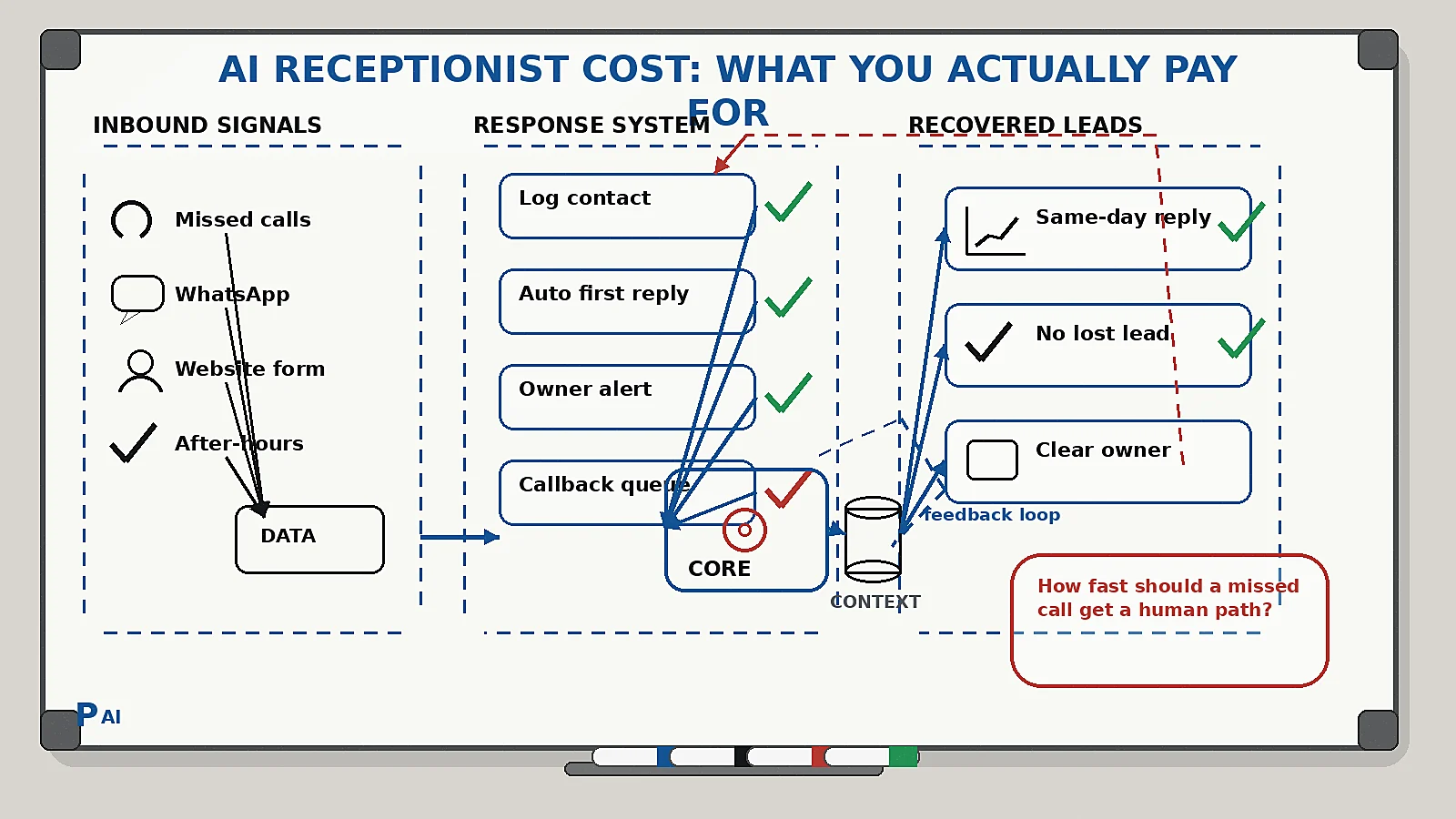
Quick answer
An AI receptionist for a small business in 2026 usually costs in bands, not one number: roughly $25–$100/month for entry SaaS, $100–$300/month for the plans most service firms actually need, $300–$1,000/month for managed or high-volume, or a $3,000–$10,000 custom build plus $100–$300/month to run. Per-minute stacks often land near $0.09–$0.36/min before agency work. Price the missed-call recovery and the human escalation path before you pick a vendor.
Why the SERP gets this wrong
Search "AI receptionist cost" and you’ll find vendor FAQs and "best of" lists that list a starting price and hide the layers that determine what you actually pay. Most pages skip:
- Setup and onboarding fees that appear after the trial
- Telephony costs (carrier minutes, SIP trunk, DID rental) billed separately
- Overage charges when call volume exceeds the plan
- The hybrid human layer — because no AI handles every call cleanly
This piece breaks the cost into four models, shows the hidden layers, and gives you a worked example so you can decide before you subscribe.
Four pricing models (what you actually pay)
| Model | Typical 2026 public range | Watch-out |
|---|---|---|
| Entry SaaS | $25–$100/mo | Minute/call caps; limited integrations; no human fallback |
| Mid-market | $100–$300/mo | CRM/calendar extras often add-ons; per-seat or per-location pricing |
| Managed / high-volume | $300–$1,000/mo | Still need human backup for exceptions; SLA tiers vary |
| Custom owned | $3k–$10k build + $100–$300/mo run | You own ops, hosting, telephony, and compliance |
Ranges cited from SuperDupr (updated Sep 2026), Scale.me AI infra, and Aira per-call bands as industry observations — not Pratap pricing.
Cost layers most quotes hide
1. Telephony (always separate)
- SIP trunk / carrier minutes: $0.005–$0.02/min for inbound; outbound often higher
- DID (phone number) rental: $1–$5/mo per number
- Porting fees: $10–$30 one-time per number
2. Setup and onboarding
- Entry SaaS: often free or $50–$200
- Mid-market: $500–$2,000 for CRM/calendar mapping, custom greetings, escalation rules
- Managed: included or $1,000–$5,000
3. Overage and scaling
- Per-minute overage: $0.10–$0.50/min above plan
- Per-call overage: $0.25–$1.00/call
- Concurrent call limits: may require plan upgrade
4. Human escalation (the real cost)
No AI receptionist handles 100% of calls without a human fallback. The question is who pays for that human:
- Vendor provides: included in managed tiers ($300–$1,000/mo)
- You provide: your staff takes escalated calls — cost is their time, not the vendor’s bill
- Hybrid: vendor answers routine, your team takes named exceptions (deposits, disputes, high-value, clinical questions)
Worked math: 80 vs 300 inbound calls/month
Assumptions (public ranges only):
- Entry SaaS: $50/mo base, 200 min included, $0.15/min overage
- Mid-market: $200/mo base, 1,000 min included, $0.10/min overage
- Average call: 2 minutes
| Volume | Entry SaaS | Mid-market | Notes |
|---|---|---|---|
| 80 calls (160 min) | $50/mo | $200/mo | Entry fits; mid-market is overbuy |
| 300 calls (600 min) | $50 + $60 overage = $110 | $200/mo | Entry overage closes gap; mid-market still safer |
Takeaway: Under ~150 calls/month, entry SaaS often wins on paper. Above that, mid-market’s included minutes and better integrations usually justify the step up — if you need the integrations.
When a bot is cheaper than a part-time hire — and when it is not
Bot wins when:
- Calls follow a repeatable pattern (booking, FAQ, confirmation, routing)
- You have a named human for exceptions (the "needs a person" rule)
- Volume is high enough to amortize setup but low enough that a full-time hire sits idle
- You need 24/7 coverage without shift costs
Human wins when:
- Every call needs judgment (clinical triage, legal intake, high-touch sales)
- Volume is very low (<20 calls/month) — setup + minimums exceed a few hours of part-time help
- You have no escalation owner and the vendor’s human layer is expensive
- Compliance requires a licensed professional on every call
Fit check: three verticals
Clinic / healthcare ops
- Pattern: After-hours booking, symptom triage routing, appointment confirmation
- Volume: 50–300 calls/month typical for single-location
- Escalation: Clinical questions → named clinician; deposits/disputes → admin
- Model fit: Mid-market ($100–$300/mo) with calendar integration + human escalation path
Site-visit real estate
- Pattern: Listing inquiry → site visit confirmation → reminder → feedback capture
- Volume: 30–150 calls/month per agent/team
- Escalation: Pricing/negotiation → agent; scheduling conflicts → coordinator
- Model fit: Entry SaaS ($25–$100/mo) often sufficient; add WhatsApp confirm layer
Restaurant / hospitality peak
- Pattern: Reservation requests, party size, special requests, walk-in conflicts
- Volume: 200–800 calls/month at peak; highly seasonal
- Escalation: Large parties, deposits, VIPs, disputes → host/manager
- Model fit: Mid-market with seasonal scaling or managed tier for peak months
Do this before you subscribe
- Map the callback window — Every missed inquiry needs a card: received at, promised window, owner, first attempt, outcome, escalate. If you can’t see the window, you don’t have a callback system. (Callback Window Card)
- Name the escalation owner — Who takes the call when AI stops? If the answer is "nobody," the bot will create more problems than it solves.
- Count your actual minutes — Pull 30 days of call logs. Multiply by average handle time. That’s your baseline.
- Test the integration — Can it write to your calendar/CRM/WhatsApp thread? If not, you’re adding a tool, not a workflow.
- Run the AI Readiness audit — Six checks (repeats, memory-held, revenue-leaking, machine-first, human-for-hard, measurable). If it scores ≤3, fix the process before you buy. (AI Readiness Checklist)
FAQ
How much does an AI receptionist cost per month?
Most small businesses land between $50–$300/month all-in (SaaS + telephony + overage). Entry plans start at $25/mo but often hit caps. Managed tiers run $300–$1,000/mo with human fallback included.
Per-minute vs per-call — which surprises SMBs?
Per-minute. A 4-minute call at $0.15/min is $0.60. Ten of those a day = $180/mo in overage on an entry plan. Per-call ($0.50–$1.00) is more predictable for short interactions but penalizes longer conversations.
Can it replace a receptionist?
For the routine layer (answer, route, confirm, remind) — yes. For the exception layer (deposits, disputes, clinical questions, high-value bookings) — no. The sustainable model is Voice handles attempt one, WhatsApp confirms, a named human owns the expired window.
What should exist before you buy?
- A callback window card with an owner for every missed inquiry
- Defined escalation rules (what triggers human, who, by when)
- Calendar/CRM that the AI can actually write to
- A WhatsApp Business API thread for confirmations and reminders (if your customers are on WhatsApp)
The bottom line
Price the missed call first. If one recovered booking covers the monthly cost, the math works. If you don’t know how many calls you miss, what they’re worth, or who takes the exception — start there. The tool is the last decision, not the first.
Want to map your after-hours leak and see which model fits? Book a 20-minute AI Readiness Call — we run the six checks and name the one workflow to fix first.